Ceramides, the heroes of the skin barrier, and beyond
A trending class of ingredients, ceramides are featured in numerous skincare products as the heroes of barrier function. And for good reason: they are naturally present in intercorneocyte lipids and are essential to the proper functioning of the skin, as well as the rest of the body. Formulating with them can sometimes be challenging, but formulation strategies make it possible to harness their multiple skin benefits beyond moisturization alone.

Ceramides have been discussed in cosmetics for several decades. They may seem like long-established ingredients, yet the current focus on skin barrier function has brought them back into the spotlight. But why are they so important, and why are they the subject of such active research?
The role of ceramides in skin barrier function
A ceramide is a sphingolipid resulting from the combination of a sphingoid base with certain fatty acids via an amide bond. However, there is a wide variety of synthetic sphingolipids, obtained by grafting other fatty acids or molecules other than fatty acids. These sphingolipids do not occur in nature, and numerous combinations are possible.
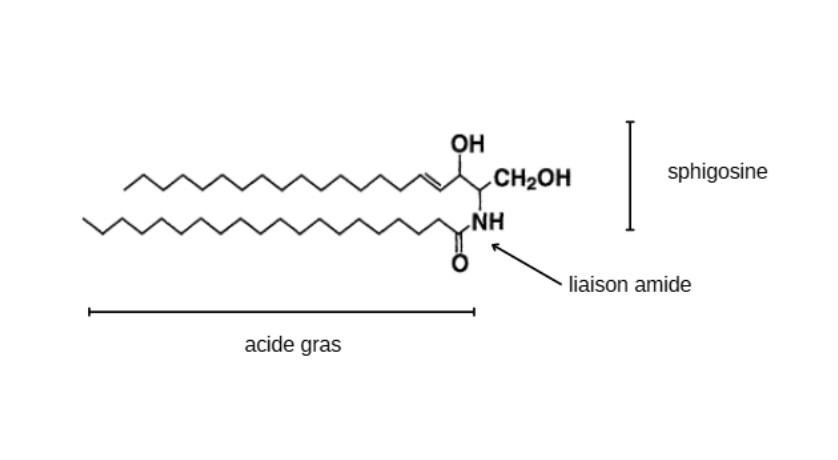
Also identified by a number, ceramides are named according to a nomenclature that takes into account:
- the type of fatty acid: N for non-hydroxy, O for omega-hydroxy, EO for ester-linked omega-hydroxy, etc.
- the sphingoid base: S for sphingosine, DH for dihydrosphingosine, etc.
Ceramide 1 is therefore renamed ceramide EOS according to this nomenclature.
Ceramides account for 50% of intercorneocyte lipids by weight, alongside free fatty acids (25%) and cholesterol (25%). This ratio may vary depending on numerous parameters such as age, external factors, or the presence of skin disorders. Around twenty different ceramides are found in the stratum corneum, in varying proportions. However, it is not the quantity of ceramides that matters most, as ceramides present in very small amounts may be crucial to the organization and structure of the intercorneocyte lipid network.
The physical component of the skin barrier is primarily ensured by the stratum corneum, according to the now well-established “brick-and-mortar” model: corneocytes are surrounded by a complex multilamellar arrangement of ceramides, cholesterol, and free fatty acids. The anchoring of certain ceramides to the cornified envelope serves as the basis for the formation of lamellar systems and the cohesion of the lipid matrix. The organization of the lipid matrix is complex and dynamic, and influences skin barrier performance and trans epidermal water loss.
Numerous factors can affect both the amount of ceramides in the stratum corneum and their relative proportions. With age and menopause, ceramide production declines, hence the interest in incorporating them into products for mature skin. Ceramide levels also vary according to body site, with the lips, for example, being almost devoid of them, as well as according to ethnicity and ceramide–microbiome interactions. Pollution, UV exposure, and smoking also modify the profile of cutaneous ceramides, likely as part of a compensatory mechanism.
Beyond barrier function
Although ceramides are now well known for their role in the stratum corneum, this broad family of molecules is involved in many other biological mechanisms within the skin, where more than 1,000 different ceramides have already been identified. The highly active research surrounding ceramides has demonstrated their value in extracellular matrix synthesis within the dermis and at the dermal, epidermal junction, with benefits for dermal density and skin firmness following topical application. Certain ceramides are also effective in addressing hyperpigmentation through a depigmenting effect.
Beyond being major components of the intercorneocyte “cement”, ceramides are present throughout the body and are involved in numerous cellular processes, although not all mechanisms have yet been fully elucidated. Their primary role is that of precursors of the sphingolipids that make up cell membranes.
They also play a role in intercellular signaling. They modulate and coordinate various cellular functions, including cell proliferation, apoptosis, and the senescence process. They are also key mediators of the cellular response to physiological or pathological stress.
Outside the skin, where ceramide levels are beneficial for barrier function, their accumulation in the rest of the body is more commonly associated with metabolic disorders.
In the hair fiber, ceramides are part of the lipid complex present between cortical cells, contributing to their cohesion.
Formulating with ceramides
Ceramides are, of course, essential in product formulations designed to strengthen or support skin barrier function, such as moisturizers, cica products, repair treatments, and related applications. It is not necessary to replicate the ratio between the different ceramides present in the intercorneocyte lipid complex in order to achieve measurable skin benefits. Even a single ceramide can provide a positive effect in a formula. The efficacy of the final formula is not necessarily correlated with the amount or concentration of ceramides. It depends on the targeted benefit and on how they are formulated. For moisturization, however, a well-designed ceramide complex will be more effective than a single ceramide, while also facilitating formulation through a lower overall use level.
Like other sphingolipids, ceramides are notoriously complex to handle in formulation, to a greater or lesser extent depending on the carbon chain length of the fatty acid. Insoluble in water and only partially soluble in oil, they generally need to be formulated at elevated temperature. Even so, they tend to recrystallize and precipitate. This is why pre-formulation is often required. Because they naturally tend to form lamellar systems, incorporating them into multilamellar structures makes them easier to formulate and helps prevent recrystallisation. This is particularly important since recrystallisation compromises ceramide efficacy once the product is applied to the skin by reducing their bioavailability. Formulating with ceramides also requires combining them with specific solubilisers and emollients. Encapsulation systems, particularly for short-chain ceramides, provide another means of facilitating formulation, including compatibility with cold-process manufacturing. This improves efficacy by promoting transport into the skin, thereby enhancing biological activity.
For the skin to recognize ceramides and use them properly, stereochemistry is of paramount importance. These molecules can adopt several different stereochemical conformations, but only dextrorotatory conformations are naturally present in the skin. Likewise, most cutaneous sphingoid bases contain only one unsaturation, whereas plant-derived ceramides, for example, generally exhibit additional unsaturations. The concept of biomimetic or “skin-identical” ceramides is therefore fundamental, since a difference in conformation leads to reduced biological activity, sometimes significantly so.
Far more diverse and biologically active than their use in moisturization alone might suggest, ceramides clearly confirm their status as hero ingredients. They are indispensable in supporting the skin barrier, but it would be limiting to confine them to these cosmetic benefits alone. Anti-ageing products, smoothing care, hair repair, scalp care, soothing for sensitive and reactive skin, and skin longevity: the range of potential benefits, and associated claims, is extensive. The highly active research surrounding ceramides will undoubtedly lead to a better understanding of their biological roles, to new applications, and perhaps even to the discovery of new ceramides.

More resources you might like