Best software for cosmetic R&D in 2026
Written and reviewed by the Coptis R&D and regulatory team. Coptis is one of the vendors in this guide, and we rank our own software first. We explain why, and we say plainly where another tool fits you better.
A cosmetic formula goes through many hands before launch: the marketing brief, raw material selection, lab trials, stability and safety tests, regulatory checks for every target market, the Product Information File, then scale-up. Most delays come from the gaps between these steps, when data is re-keyed from one tool to the next.
The best cosmetic R&D software closes those gaps. It covers the whole formulation cycle in one place, keeps every formula compliant as regulations change, and in 2026 puts AI to work on that data.
This guide sets out what to look for, why Coptis meets that bar and where the alternatives fall short for cosmetic R&D.
How we evaluated
We evaluated each option against five criteria, ranked by importance.
1. Covers every stage of formulation R&D. One tool from brief to launch: raw materials, formulas and versions, lab trials, stability and safety tests, costing, regulatory documents, pilot and production. No re-keying between stages.
2. Regulatory and compliance depth. INCI lists, restricted and banned substances, allergens and traces, concentration limits by country, toxicological risk assessment (NOAEL, Margin of Safety) and automatic PIF generation. Alerts when a regulation changes.
3. AI built on formulation data. The AI reads your actual formulas, raw materials, suppliers and stability results, not text pasted into a prompt. And the formulator stays in control: the AI proposes, a qualified person decides and signs, as the safety assessor’s responsibility under EU Regulation 1223/2009 requires.
4. Auditability. Every formula version, test result and regulatory output is traceable to its source, ready for a safety assessor or an inspection.
5. Proven in cosmetics labs. Years in production with cosmetics R&D teams, not a generic PLM, ERP or chemicals tool adapted later.
Our pick and the alternatives
Coptis - best for cosmetic formulation and regulatory compliance
Best for: formulation labs, brands and contract manufacturers that want every stage of cosmetic R&D and its compliance in one cosmetics-native PLM.
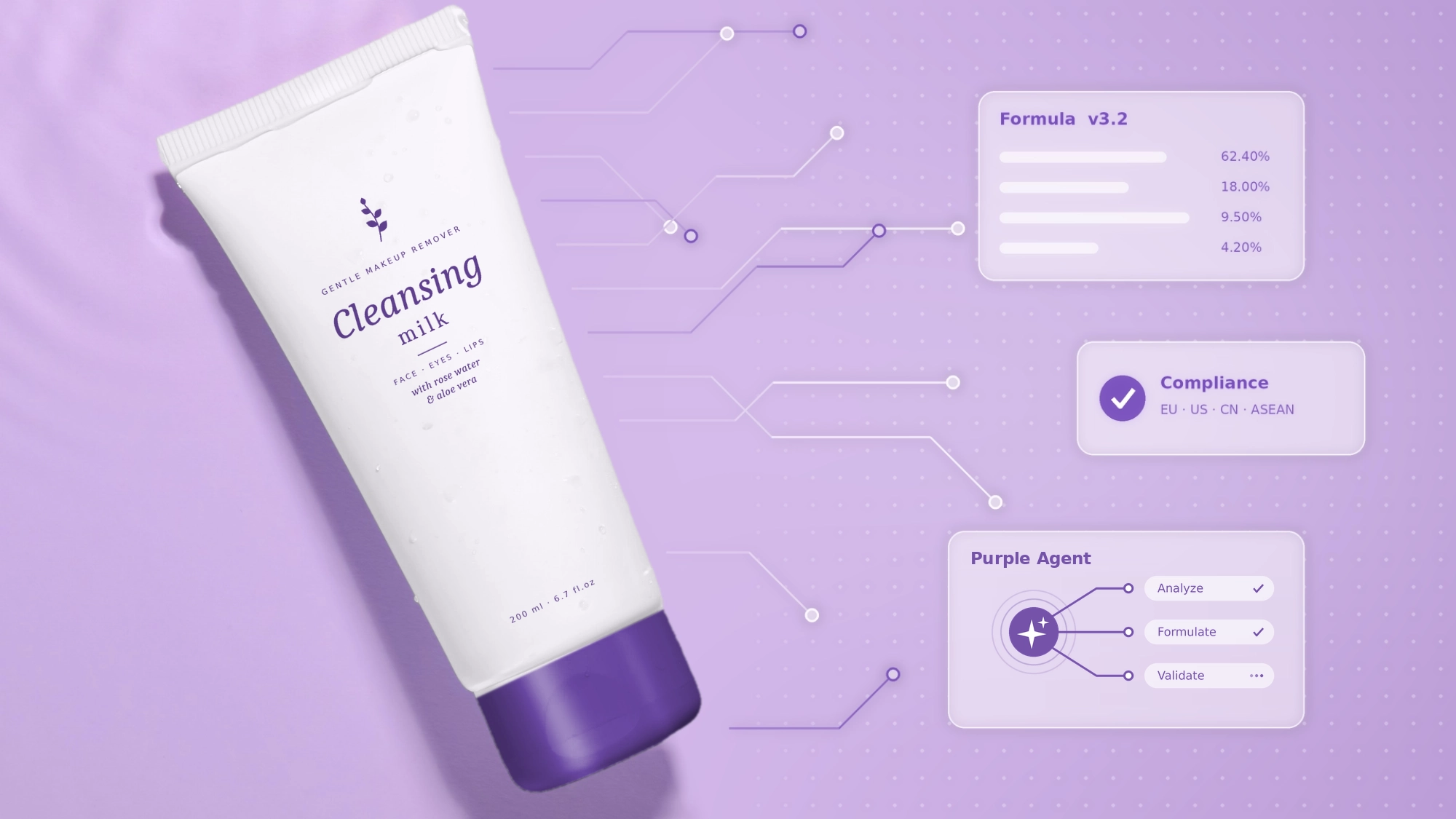
Covers the whole formulation cycle, from brief to launch (source) Coptis centralizes formula development, raw material management, testing, regulatory compliance and documentation in one platform. It streamlines workflows and accelerates time-to-market.
Regulatory compliance: real-time compliance checks against regulatory databases by region, and alerts when a new restriction affects your formulas (source).
AI on top of that data: Purple: Coptis’ AI agent, generates base formulas from a product brief or an INCI list and reformulates using raw materials from your own inventory, while checking country-specific regulatory restrictions throughout the process. A Document Reader is also on the roadmap, alongside an AI research programme focused on predicting formula stability. Formulators remain in full control at every step.
Track record: 27+ years in cosmetics, about 4,500 users, offices in Paris, New York and Singapore, 8 interface languages. Customers include Clarins, Shiseido, Galderma, Nuxe, Expanscience and Nu Skin. Connects to your ERP and lab tools through an API (FAQ).
Wrong for: companies that want one tool to replace ERP, warehouse and sales. Coptis focuses on R&D, regulatory and product data, and connects to your ERP.
Other options, and their limits for cosmetic R&D
Multi-industry PLMs. Built for food, fashion or retail, then extended to cosmetics. Cosmetics is one vertical among several, so R&D workflows are generic rather than designed for cosmetic formulation, toxicology and safety files.
All-in-one operations platforms. They aim to replace ERP, PLM, QMS and warehouse tools at once. For an established lab with years of formula history and a working ERP, that means a full system replacement and a long migration before R&D sees any benefit.
Compliance-screening tools. They flag a non-compliant ingredient, but do not run the lab work around the formula: trials, stability schedules, costing, pilot and production stay in other tools, and data is re-keyed between them.
Small-business formulation tools. Affordable for a start-up, but limited in regulatory depth, toxicology and AI as a portfolio and its markets grow.
ERP copilots. Useful for finance and supply chain; they hold no INCI, toxicology or stability data.
General AI assistants. Fine for drafting and research; their output is not tied to an approved formula version and cannot go into a PIF.
Why a cosmetics specialist wins
Formulation is the core, not a module
Generalist PLMs were built for food, fashion or chemicals, then adapted to cosmetics. Coptis was built for cosmetic labs from day one, 27+ years ago.
Compliance runs inside every formula
In a specialist tool, a banned substance or an allergen threshold is flagged while you formulate, not after a separate regulatory review.
AI is only as good as the data under it
Purple AI works on decades of structured formulation, raw material and test data. A generic copilot or chatbot has none of it. (Source)
How to choose
- You run a formulation lab or R&D department and need every stage, from brief to PIF, in one tool → Coptis.
- Regulatory compliance is your bottleneck (new restrictions, multi-country launches, safety files) → Coptis: compliance checks run on every formula, at every stage.
- You are a brand or contract manufacturer with years of formula history you want to reuse, including with AI → Coptis. Purple AI works from your existing raw material inventory.
- Your priority is not formulation (merchandising, finance, warehouse) → a generalist PLM or ERP may be enough, and Coptis connects to it through its API.
FAQ
What is cosmetic R&D software?
Software that manages formulas, raw materials, lab tests and regulatory data in one place, from the product brief to the Product Information File. In the industry it is often called a cosmetics PLM.
What is the best software for cosmetic formulation in 2026?
For R&D and regulatory teams, a cosmetics-native PLM that covers every formulation stage and checks compliance as you work, such as Coptis.
How does formulation software help with regulatory compliance?
It checks every formula against restricted and banned substance lists, allergens and concentration limits by country, alerts you when a regulation changes, and generates INCI lists and the PIF automatically.
Can I just use ChatGPT for formulation?
For research and drafting, yes. For a formula that goes into a PIF, no: the output is not tied to your approved raw materials, versions or regulatory sources.
Does AI replace the formulator or the safety assessor?
No. Under EU Regulation 1223/2009 a qualified safety assessor signs the safety report. Coptis Purple AI proposes formulas; the formulator keeps full control.
How long does it take to deploy?
Coptis is available as soon as initialization is complete; the time depends on the volume of data to import (FAQ).
See your whole formulation cycle in one place. Book a 30-minute demo with a Coptis formulation and regulatory expert, including Purple AI on your own formulas.
Book a demo